
Shopping Cart
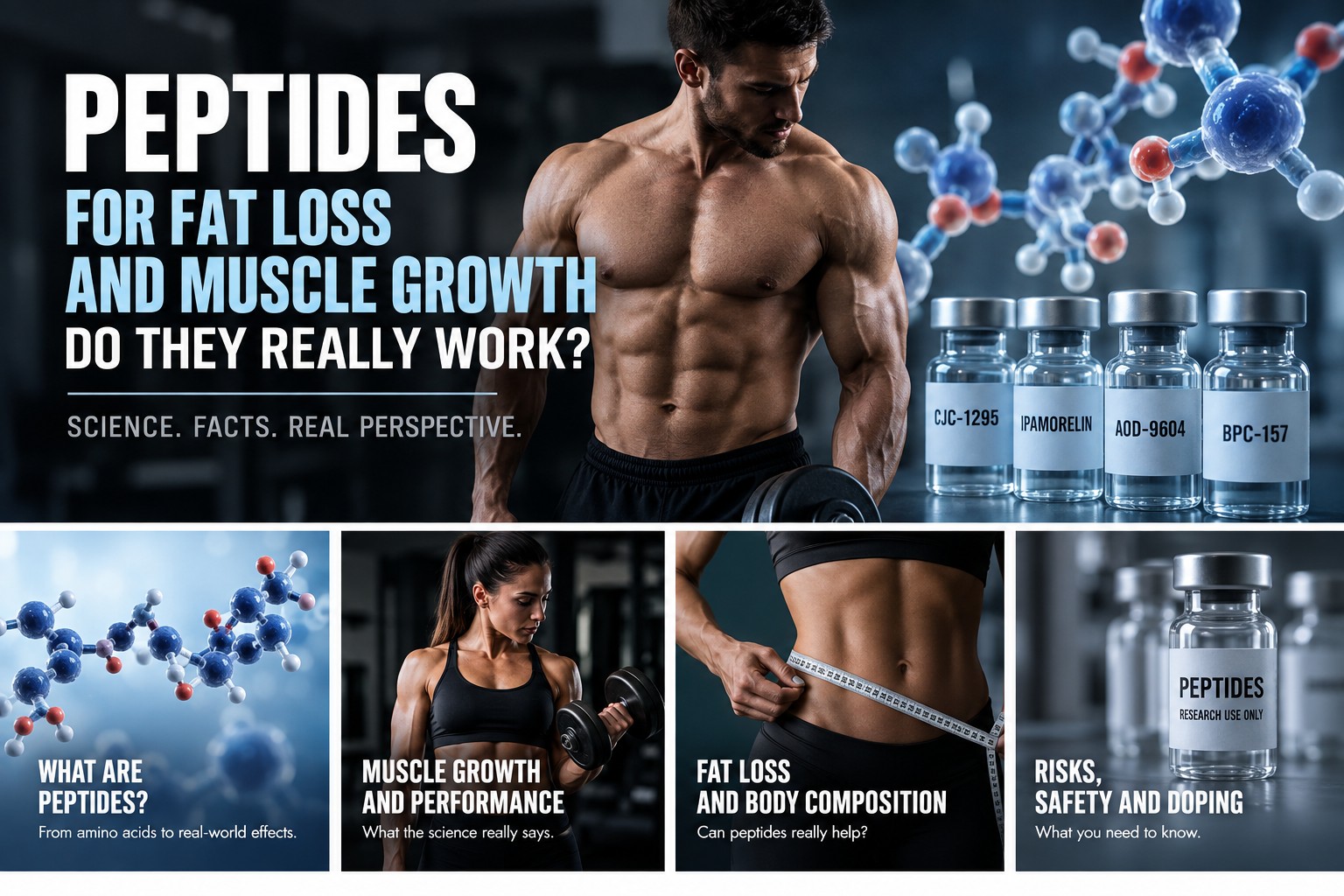
Peptides for Fat Loss & Muscle Growth: Do They Work?


Peptides are becoming increasingly popular across social media, gyms and bodybuilding communities. They are often promoted as the latest shortcut to build muscle, accelerate fat loss, improve recovery and enhance physical performance. Some online claims even describe certain peptides as alternatives to anabolic steroids.
But how much of this is actually supported by science?
The answer requires some caution. “Peptides” describes a very broad group of compounds, and some peptide-based medicines have legitimate and well-established medical uses. This is very different from the growing market for so-called research peptides promoted for bodybuilding, muscle growth or fat loss.
In this guide, we look at what peptides are, why they have become so popular in bodybuilding, what current research actually tells us and why proven strategies involving nutrition, training and evidence-based supplementation remain the foundation for improving body composition.
What are peptides?
Peptides are short chains of amino acids. In simple terms, they can be thought of as smaller relatives of proteins.
Many peptides occur naturally in the human body and are involved in important biological processes. Others have been developed as medicines for specific medical conditions.
This is an important distinction: a medically approved peptide drug is not the same thing as an unapproved peptide sold online for bodybuilding or performance enhancement.
Products commonly discussed in fitness and bodybuilding communities include compounds such as CJC-1295, ipamorelin, GHRP-2, GHRP-6, AOD-9604 and BPC-157. They do not all work in the same way and should not be treated as a single category with identical effects or risks.
Why have peptides become so popular in bodybuilding?
The appeal is easy to understand. Online discussions frequently associate peptides with highly desirable outcomes:
- increased muscle mass;
- faster fat loss;
- improved recovery;
- increased growth hormone activity;
- better performance;
- support for tendons and connective tissues.
The problem is that marketing claims and anecdotal experiences can move much faster than scientific evidence.
A 2026 critical review of peptide and peptide-analogue drugs in sport and bodybuilding concluded that clinical evidence supporting their use in sport remains limited. Much of the available research concerns therapeutic applications under controlled medical conditions rather than the doses, combinations and protocols discussed in bodybuilding communities.
Are peptides as powerful as anabolic steroids?
This is one of the most misleading comparisons circulating online.
Peptides and anabolic-androgenic steroids are different classes of substances with different mechanisms of action. It therefore makes little scientific sense to claim generally that “peptides are as powerful as steroids”.
Some peptides may influence hormonal pathways or biological processes involved in growth, metabolism or recovery. That does not automatically mean they produce the same effects as anabolic steroids, nor does it establish that they are safer.
Statements such as “the benefits of steroids without the side effects” should therefore be treated with considerable scepticism.
What about so-called fat-burning peptides?
Another rapidly growing trend involves peptides promoted specifically for fat loss.
Compounds such as AOD-9604 are frequently discussed online as “fat-burning peptides”. However, mechanistic theories, animal studies or preliminary research should not be confused with solid evidence of meaningful fat loss in healthy people using these substances for physique purposes.
For anyone trying to reduce body fat, the fundamentals remain far less exciting — but much better established: an appropriate calorie deficit, sufficient protein intake, resistance training, physical activity and consistency over time.
If your goal is cutting while preserving lean mass, read our guide to supplements for cutting and explore our Weight Management section.
What do we know about peptide safety?
This is where the discussion becomes particularly important.
For several peptides promoted online for physique or performance purposes, long-term safety data in healthy users are limited or insufficient.
The U.S. Food and Drug Administration has highlighted safety concerns or insufficient safety information for a number of substances used in compounded preparations, including compounds frequently mentioned in peptide communities such as ipamorelin, AOD-9604, BPC-157 and CJC-1295.
Potential concerns vary according to the substance and may include immunogenicity, impurities, cardiovascular effects and other adverse reactions. It would be incorrect to claim that every peptide necessarily causes these problems, but it is equally incorrect to assume that a substance is safe simply because it is marketed as a peptide.
Buying peptides online adds another layer of risk
The scientific uncertainty is only part of the issue.
Many products marketed as “research peptides” are sold through channels outside conventional pharmaceutical distribution. This raises additional questions about:
- the actual identity of the substance;
- purity and concentration;
- contamination;
- sterility of injectable products;
- storage conditions;
- accuracy of the label.
A product labelled “for research use only” should not be interpreted as a guarantee of pharmaceutical quality or suitability for human use.
Peptides and doping: what athletes need to know
Competitive athletes need to be particularly careful.
Anti-doping regulations prohibit a number of peptide hormones, growth factors, growth-hormone-releasing factors and related substances. Compounds frequently discussed in bodybuilding communities can therefore create serious problems for athletes subject to anti-doping rules.
Being available online does not mean that a substance is permitted in sport.
Peptides and dietary supplements are not the same thing
This distinction is essential.
Dietary supplements such as whey protein or creatine are not pharmacological substitutes for peptides and should never be presented as if they produced the same effects.
Their advantage is different: certain supplements have been studied extensively and can support nutrition and training when used appropriately.
| Research peptides | Evidence-based supplements |
|---|---|
| May influence specific biological or hormonal pathways | Primarily support nutrition and exercise performance |
| Evidence for bodybuilding use is often limited | Some ingredients have extensive sports-nutrition research |
| Long-term safety may be uncertain | Safety profiles are generally better characterised when correctly used |
| Online products may present purity or sterility concerns | Legitimate supplements are sold as food products under applicable regulations |
| Some substances are prohibited in competitive sport | Common ingredients such as protein and creatine are not inherently prohibited substances |
Want to build muscle? Start with what we know works
If your goal is muscle growth, there is no need to begin with experimental compounds.
The foundations remain:
- progressive resistance training;
- adequate energy intake;
- sufficient daily protein;
- good sleep and recovery;
- consistency over months and years.
When food alone does not conveniently provide enough protein, protein powders can help you reach your daily intake. Whey protein is particularly practical because it provides high-quality protein and essential amino acids.
For more detail, see our guide How Much Protein Do I Need Per Day? and our Whey Protein Powder Guide.
Another extensively researched option is creatine, particularly creatine monohydrate, which can support high-intensity exercise performance and training adaptations.
You can learn more in our guide to creatine monohydrate dosage and daily use.
Want to lose fat? No “fat burner” replaces your diet
Fat loss ultimately requires an energy deficit over time.
Supplements can sometimes play a supporting role, but they cannot compensate for an unsuitable diet or inconsistent training.
Maintaining adequate protein intake is particularly useful during a calorie deficit because it contributes to the maintenance of muscle mass. Resistance training also provides an important stimulus for preserving lean tissue.
For a broader look at this category, read our guide to fat-burning supplements and explore our Weight Management section.
Peptides or supplements? That is the wrong question
It is tempting to ask which option is “stronger”. But this creates a false comparison.
Peptides, medicines and dietary supplements belong to different categories and have different purposes.
A protein powder helps you meet your protein requirements. Creatine can support performance during repeated high-intensity efforts. Neither is intended to reproduce the pharmacological activity of an experimental peptide.
For most people who want to become stronger, build muscle or improve body composition, the sensible starting point is not to search for the most powerful compound available. It is to optimise the fundamentals that consistently produce results.
The right question is not only “does it work?” but “how much do we know?”
Fitness trends often follow the same pattern: a substance becomes popular, dramatic transformations appear on social media, testimonials multiply and scientific certainty is assumed long before it actually exists.
Peptides deserve serious scientific research. Some may eventually prove useful for specific medical applications, and some peptide-based medicines already are.
But that does not justify treating every peptide marketed for bodybuilding or fat loss as proven, safe or appropriate for self-experimentation.
Build results instead of chasing shortcuts
There is nothing wrong with wanting faster progress. But muscle growth, strength and sustainable fat loss are adaptations that take time.
Before chasing the latest bodybuilding trend, make sure the basics are already in place: training, protein, calories, sleep, recovery and consistency.
Body Nutrition has been supporting athletes and fitness enthusiasts since 2001. Our approach is simple: use supplementation to complement a solid nutrition and training strategy — not to replace it.
Scientific and institutional sources
- U.S. Food and Drug Administration (FDA) — information on bulk drug substances used in compounding that may present significant safety risks.
- World Anti-Doping Agency (WADA) — Prohibited List and regulations concerning peptide hormones, growth factors and related substances.
- Recent peer-reviewed reviews on peptide and peptide-analogue use in sport and bodybuilding, including literature published in 2026.
This article is for informational purposes only and does not constitute medical advice. The use of medicines, experimental compounds or substances intended to modify hormonal function should always be discussed with a qualified healthcare professional. Competitive athletes should also verify the current anti-doping status of any substance before use.
Share this article: