Shopping Cart
Creatine monohydrate: complete guide to dosage and daily use


Creatine monohydrate is one of the most extensively studied sports supplements, yet its everyday use still generates plenty of questions. How many grams should you take? Do you need a loading phase? Should you take it before or after training? And what happens on rest days?
The good news is that creatine supplementation does not need to be complicated. For most people, the practical approach is remarkably simple: take an appropriate amount consistently and allow muscle creatine stores to increase over time.
This guide explains how creatine monohydrate works, the commonly studied dosage strategies and how to fit it into a normal training routine.
What is creatine monohydrate?
Creatine is a naturally occurring compound produced by the body from amino acids and also obtained from foods, particularly meat and fish.
Most of the body's creatine is stored in skeletal muscle, where creatine and phosphocreatine participate in the rapid regeneration of ATP, the immediate energy currency used by cells.
Creatine monohydrate is the form most extensively investigated in sports nutrition research. Supplementation can increase intramuscular creatine stores, providing greater availability of the creatine-phosphocreatine energy system.
What does creatine actually do?
During short, intense exercise, ATP is used rapidly. Muscle cells therefore need mechanisms capable of regenerating ATP quickly enough to continue producing force.
Phosphocreatine helps donate a phosphate group that can be used to regenerate ATP.
Increasing muscle creatine stores can therefore help support performance during activities involving repeated bouts of high-intensity effort.
This is why creatine is particularly associated with resistance training, sprinting, explosive exercise and other activities requiring repeated high-power efforts.
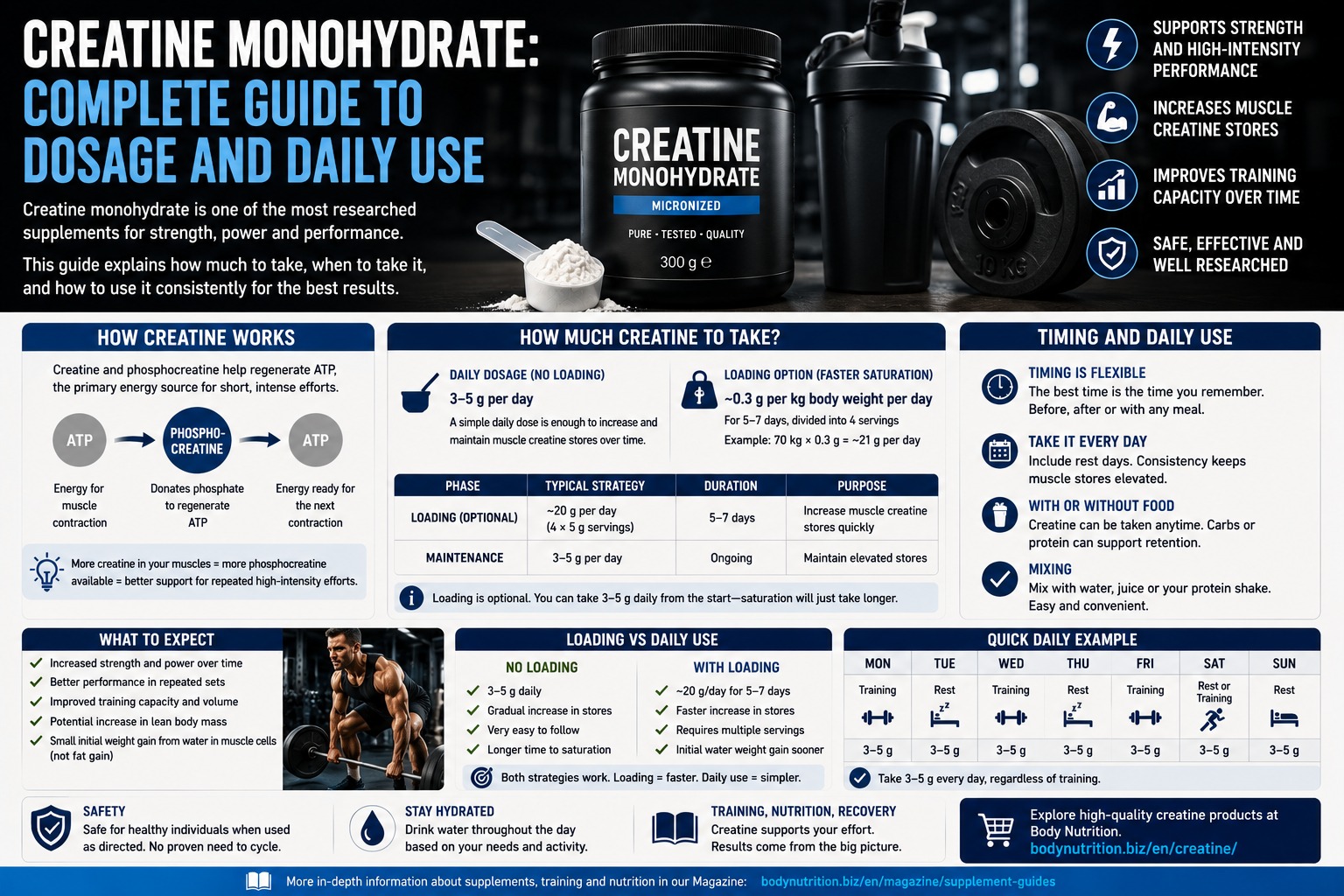
How much creatine should you take per day?
For everyday supplementation, approximately 3–5 g of creatine monohydrate per day is one of the most commonly used and researched strategies.
Once muscle creatine stores are elevated, this amount is generally sufficient to help maintain them in many adults.
A larger body size and individual differences in muscle mass and creatine metabolism can influence requirements, so there is no need to treat exactly 5 g as a biological threshold that applies identically to everyone.
Do you need to calculate creatine according to body weight?
For normal daily use, most people do not need a complicated calculation. A simple daily serving in the 3–5 g range is widely used.
Body-weight calculations are more commonly encountered in research protocols, particularly during loading.
A frequently studied loading strategy uses approximately 0.3 g of creatine per kilogram of body weight per day for several days.
For a 70 kg person, for example:
70 × 0.3 = approximately 21 g per day during loading
This amount would normally be divided into several smaller servings rather than consumed all at once.
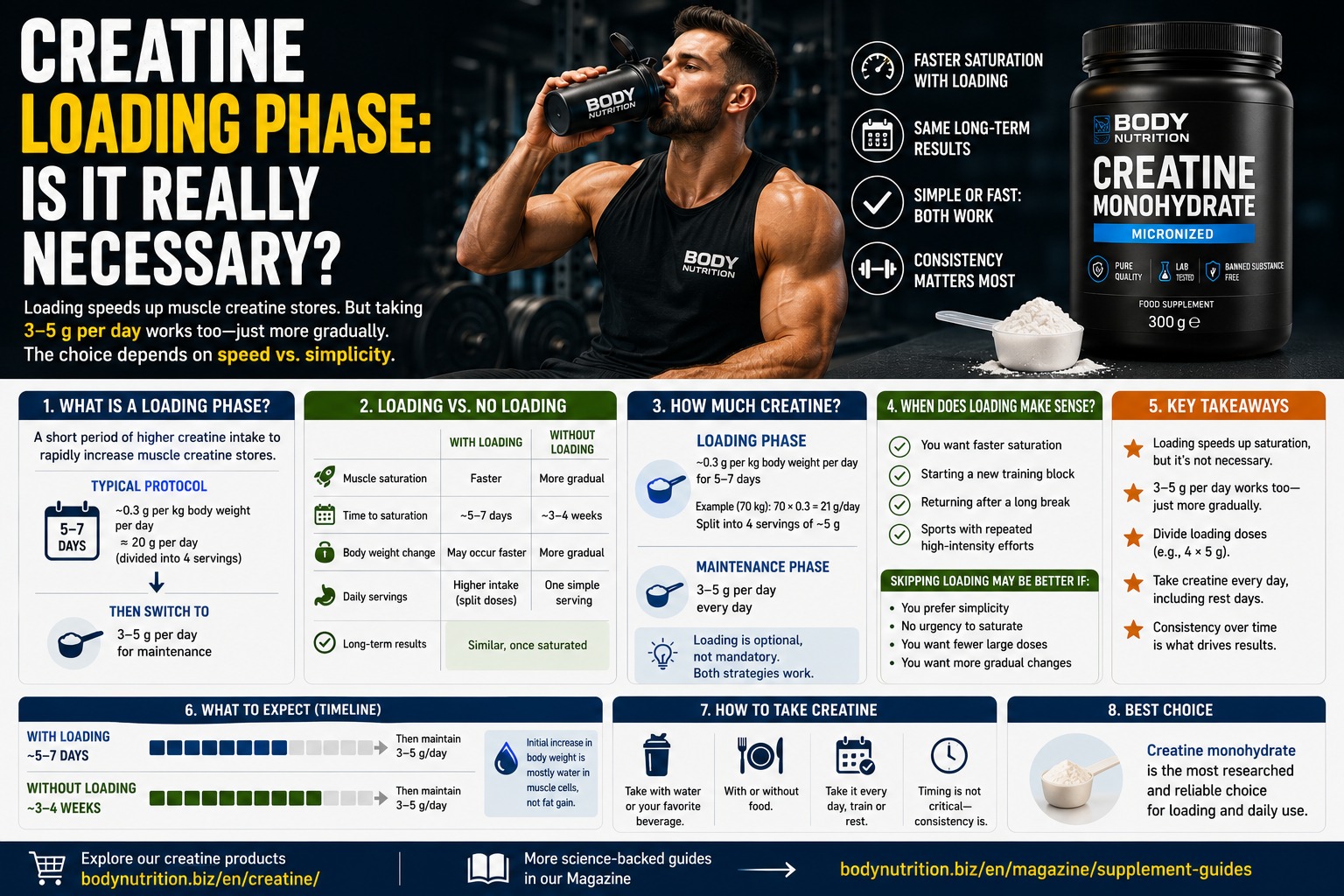
What is the creatine loading phase?
A loading phase is a strategy designed to increase muscle creatine stores relatively quickly.
A commonly studied protocol is approximately 20 g per day, divided into four 5 g servings, for around 5–7 days.
After this period, intake is reduced to a maintenance amount, commonly around 3–5 g per day.
| Phase | Typical strategy | Purpose |
|---|---|---|
| Loading | About 20 g/day divided into several servings for 5–7 days | Increase muscle creatine stores quickly |
| Maintenance | About 3–5 g/day | Maintain elevated creatine stores |
Is creatine loading necessary?
No. You can use creatine effectively without performing a loading phase.
Taking approximately 3–5 g every day will also increase muscle creatine stores. The main difference is that saturation occurs more gradually.
Research comparing the two approaches has shown that lower daily doses can eventually produce similar increases in muscle creatine stores to a rapid loading strategy.
Loading should therefore be viewed as a way of getting there faster, not as a requirement for creatine to work.
Loading vs daily use: which approach should you choose?
| Without loading | With loading |
|---|---|
| Simple 3–5 g daily routine | Higher intake for approximately 5–7 days |
| Gradual increase in muscle stores | Faster increase in muscle stores |
| Easy to remember | Requires several daily servings initially |
| Potentially less rapid change in body weight | Initial water-related weight gain may occur sooner |
| Suitable for long-term routine | Useful when rapid saturation is desired |
For most recreational athletes, simply taking creatine consistently every day is perfectly practical.
How long does creatine take to work?
The answer depends largely on whether you perform a loading phase.
With loading, muscle creatine stores can rise substantially within approximately one week.
Without loading, daily intake of around 3–5 g increases stores more gradually, commonly over several weeks.
This also explains why judging creatine after only one or two workouts makes little sense. Creatine is primarily a saturation-based supplement rather than an acute stimulant.
Should you take creatine before or after training?
For most people, consistency matters more than precise timing.
Creatine does not work like caffeine, where the timing of a single dose can strongly influence its acute effects during a particular workout.
The goal is to increase and maintain muscle creatine stores over time.
You can therefore take creatine:
- with breakfast;
- with a pre-workout meal;
- after training;
- with another meal;
- at any other convenient time that helps you remember it.
The best time is often simply the time you are most likely to take it consistently.
Should you take creatine on rest days?
Yes. If you use creatine as a daily supplementation strategy, it makes sense to continue taking it on non-training days.
The purpose is to maintain elevated tissue stores, not simply to provide something immediately before exercise.
Your muscles also continue recovering and adapting between training sessions, so there is generally no reason to repeatedly stop and restart creatine according to your weekly workout schedule.
Do you need to cycle creatine?
There is no established requirement to cycle creatine by taking it for several weeks and then deliberately stopping for a predetermined period.
Creatine stores gradually decline after supplementation is discontinued rather than collapsing immediately.
For someone who wants to use creatine continuously alongside training, a regular daily strategy is considerably simpler than repeatedly cycling on and off.
What happens if you forget one day?
Missing a single serving is unlikely to make a meaningful difference once your muscle creatine stores are elevated.
You do not need to double the next day's serving simply because you forgot yesterday's dose.
Just return to your normal daily routine.
This is another consequence of creatine working through the gradual elevation of tissue stores rather than through the immediate effect of a single dose.
Should creatine be taken with food?
Creatine can be taken with or without food.
Research has shown that consuming creatine alongside carbohydrate, or carbohydrate plus protein, can increase creatine retention under some conditions.
That does not mean you need a special high-carbohydrate meal every time you take creatine.
For practical daily use, taking it with a normal meal can simply make the routine easier to remember.
Can you mix creatine with a protein shake?
Yes. Creatine monohydrate can conveniently be added to a protein shake.
There is no requirement to keep whey protein and creatine separate.
The two supplements serve different purposes: protein provides amino acids, while creatine increases the availability of creatine and phosphocreatine within tissues.
Combining them in the same shake is therefore primarily a matter of convenience.
Creatine and water: does it cause water retention?
Creatine supplementation can increase body water, particularly during the initial stages of supplementation.
This occurs largely because increasing muscle creatine content is associated with changes in water within muscle tissue.
For this reason, some people notice a relatively quick increase in body weight, particularly when using a loading phase.
This should not automatically be interpreted as fat gain.
Does creatine make you gain fat?
Creatine itself does not directly increase body fat.
A rise on the scale during the first days or weeks of supplementation can be related to changes in body water.
Long-term changes in fat mass are determined primarily by energy balance rather than by creatine supplementation itself.
Which type of creatine should you choose?
Creatine is available in numerous forms, but creatine monohydrate remains the benchmark against which alternative forms are generally compared.
It has extensive research supporting its ability to increase muscle creatine stores and improve performance during appropriate forms of exercise.
Claims that another form is automatically superior because it sounds more technologically advanced should therefore be evaluated carefully.
You can compare available products in the Creatine category at Body Nutrition.
What does “micronized creatine” mean?
Micronized creatine monohydrate consists of creatine particles that have been processed to a smaller particle size.
This may improve how easily the powder disperses in liquid and can make it more convenient to mix.
It should not, however, be interpreted as a completely different form of creatine with fundamentally different physiological effects. It remains creatine monohydrate.
How should creatine be mixed?
Creatine monohydrate can be mixed with water or another beverage and consumed according to the product instructions.
Some powders dissolve more readily than others depending on particle size, liquid volume and temperature.
Complete visual disappearance of every particle is not necessary for creatine to be usable.
Do you need to drink huge amounts of water with creatine?
Creatine does not mean you need to force yourself to consume excessive amounts of water.
Normal hydration should instead reflect factors such as:
- body size;
- training duration and intensity;
- temperature and humidity;
- sweat losses;
- diet;
- individual needs.
Maintaining appropriate hydration is important for athletes regardless of whether they use creatine.
Does creatine cause dehydration or muscle cramps?
The available research does not support the common claim that recommended creatine supplementation causes dehydration or muscle cramping in healthy users.
These concerns became widespread during the early years of creatine use, but controlled research has not confirmed them as expected consequences of supplementation.
Is creatine safe for the kidneys?
In healthy individuals, creatine supplementation at commonly recommended amounts has not been shown to damage kidney function.
There is, however, an important practical detail: supplementation may influence measurements related to creatinine, a compound commonly used when evaluating kidney function.
Anyone undergoing medical tests should therefore tell their healthcare professional about supplements they are taking.
People with kidney disease, other medical conditions, or medications that may affect kidney function should seek medical advice before starting supplementation.
Can you use creatine for months or years?
Creatine monohydrate has been investigated in both short- and longer-term supplementation studies.
For healthy adults, the scientific literature provides substantial safety data when creatine is consumed appropriately.
As with any supplement, however, appropriate use does not mean that more is always better. There is no practical reason to continually increase the dose once muscle stores are adequately maintained.
Who may respond particularly well to creatine?
The increase in muscle creatine after supplementation varies between individuals.
People starting with relatively lower muscle creatine stores may experience a larger increase than those whose stores are already comparatively high.
Habitual diet can be one factor because foods such as meat and fish contain creatine, while plant foods generally contain very little.
Training status, muscle mass and individual physiology can also contribute to differences in response.
What should you realistically expect from creatine?
Creatine is not a shortcut that replaces training.
Its most established sporting role is supporting performance during high-intensity, repeated exercise. Over time, being able to sustain training quality can contribute to improved training adaptations.
A realistic strategy therefore combines:
- progressive resistance or sport-specific training;
- adequate energy intake;
- sufficient protein and carbohydrate;
- appropriate hydration;
- adequate sleep and recovery;
- consistent creatine intake.
For more practical information on supplements, dosage and how to choose products, explore the Supplement Guides section of the Body Nutrition Magazine.
Simple creatine routine: a practical example
For someone who does not need rapid saturation, a simple routine could look like this:
| Day | Training | Creatine |
|---|---|---|
| Monday | Training | 3–5 g |
| Tuesday | Rest | 3–5 g |
| Wednesday | Training | 3–5 g |
| Thursday | Rest | 3–5 g |
| Friday | Training | 3–5 g |
| Saturday | Rest or training | 3–5 g |
| Sunday | Rest | 3–5 g |
There is nothing sophisticated about it, and that is precisely the point: effective creatine use can be extremely simple.
Creatine monohydrate: 7 key points to remember
- Creatine monohydrate is the most extensively studied form.
- Approximately 3–5 g per day is a common daily strategy.
- A loading phase is optional, not mandatory.
- Take creatine on rest days as well as training days.
- Consistency matters more than precise timing.
- An initial increase in body weight can reflect changes in muscle water, not fat gain.
- Creatine supports training; it does not replace training, nutrition or recovery.
Conclusion: keep creatine supplementation simple
Despite the enormous amount of discussion surrounding creatine, everyday supplementation does not need to be complicated.
For many healthy adults involved in resistance training or high-intensity sport, 3–5 g of creatine monohydrate taken consistently each day is a straightforward strategy for gradually increasing and maintaining muscle creatine stores.
A loading phase can achieve saturation more quickly, but it is optional. Precise timing is also secondary to consistency, which means creatine can be fitted into whichever part of your daily routine makes adherence easiest.
The most important point is to keep the supplement in perspective: creatine can support performance and training adaptations, but progressive training, nutrition and recovery remain the foundations of results.
Frequently asked questions
Is 5 g of creatine every day enough?
For many adults, 3–5 g of creatine monohydrate per day is a commonly used amount for maintaining elevated muscle creatine stores after saturation.
Do I need 20 g of creatine per day?
No. Approximately 20 g per day is commonly associated with an optional short loading phase. A lower daily amount can also increase muscle creatine stores, but more gradually.
Should I take creatine every day?
A consistent daily routine is the simplest strategy for maintaining elevated creatine stores, including on days when you do not train.
Should I take creatine before or after my workout?
For routine supplementation, consistency is generally more important than whether creatine is consumed immediately before or after training.
Do I need to cycle off creatine?
There is no established requirement to periodically cycle off creatine in healthy users simply to make supplementation continue working.
What is the best form of creatine?
Creatine monohydrate remains the most extensively researched form and is the standard against which alternative forms are generally compared.
Recommended products

Share this article: