Shopping Cart
Creatine loading phase: is it really necessary?


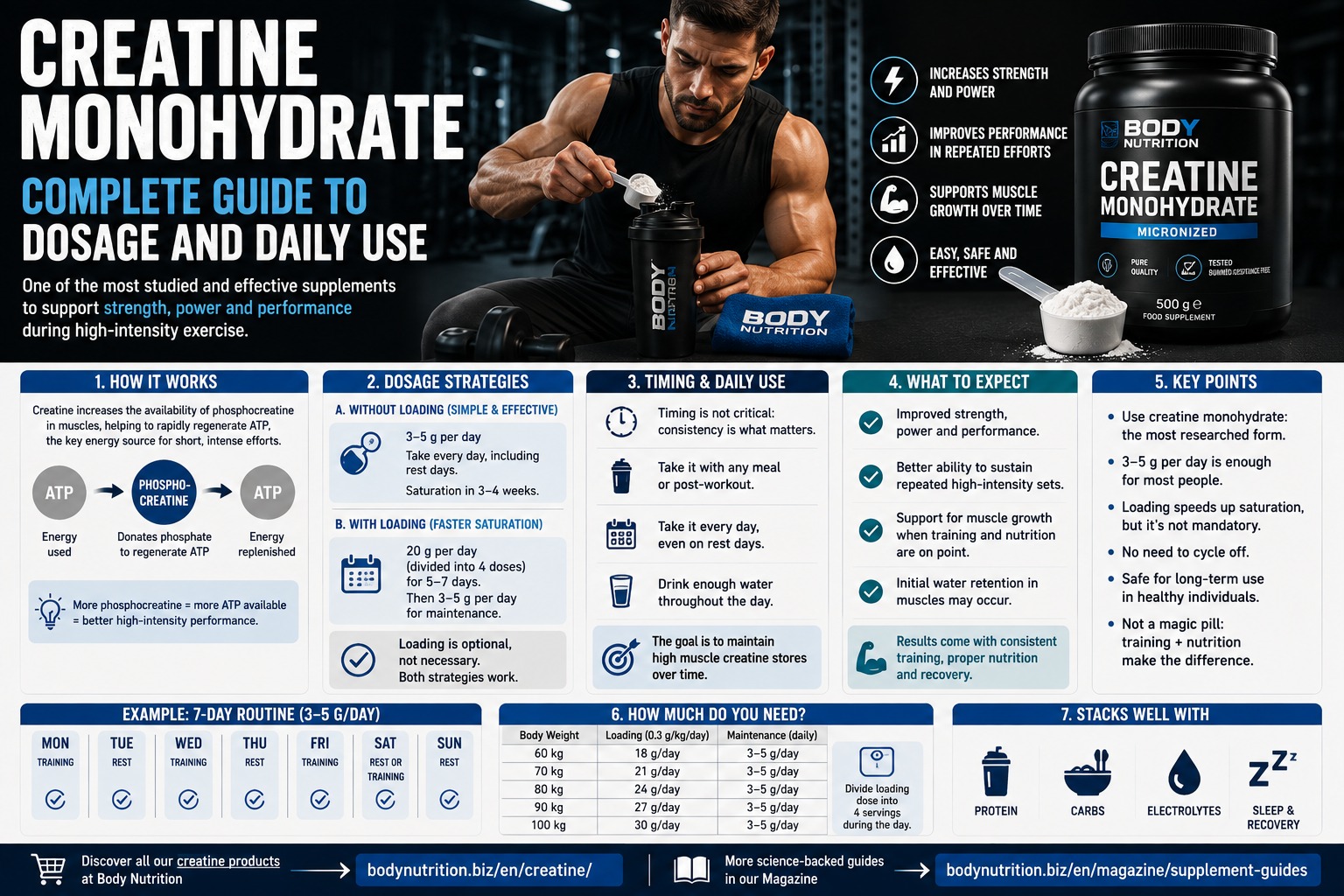
If you have ever looked up how to take creatine, you have probably encountered the classic creatine loading phase: around 20 g per day for several days, followed by a smaller maintenance dose.
But is loading actually necessary for creatine to work? No. A loading phase is simply a way to increase muscle creatine stores more quickly. Taking a smaller dose every day can ultimately achieve the same goal, but it takes longer.
The real choice is therefore not between a strategy that works and one that does not. It is mainly a choice between faster saturation and a simpler daily routine.
What is a creatine loading phase?
Creatine loading involves consuming a relatively high amount of creatine for a short period in order to rapidly increase the amount stored in skeletal muscle.
A commonly studied protocol uses approximately 0.3 g of creatine per kilogram of body weight per day for 5–7 days.
In practical terms, this is often simplified to around 20 g per day divided into four 5 g servings.
After the loading period, intake is reduced to a maintenance amount, commonly around 3–5 g per day.
| Phase | Typical intake | Duration |
|---|---|---|
| Loading | Approx. 20 g/day divided into several servings | 5–7 days |
| Maintenance | Approx. 3–5 g/day | Ongoing |
Why do people load creatine?
The purpose is straightforward: speed.
Muscles already contain creatine naturally. Supplementation increases those stores, but the increase does not happen instantly.
Using a loading protocol allows muscle creatine concentrations to rise substantially within a relatively short period. This means the potential performance benefits associated with elevated stores may also become available sooner.
Loading does not make creatine inherently more effective. It simply allows you to reach elevated muscle stores more rapidly.
Is creatine loading necessary?
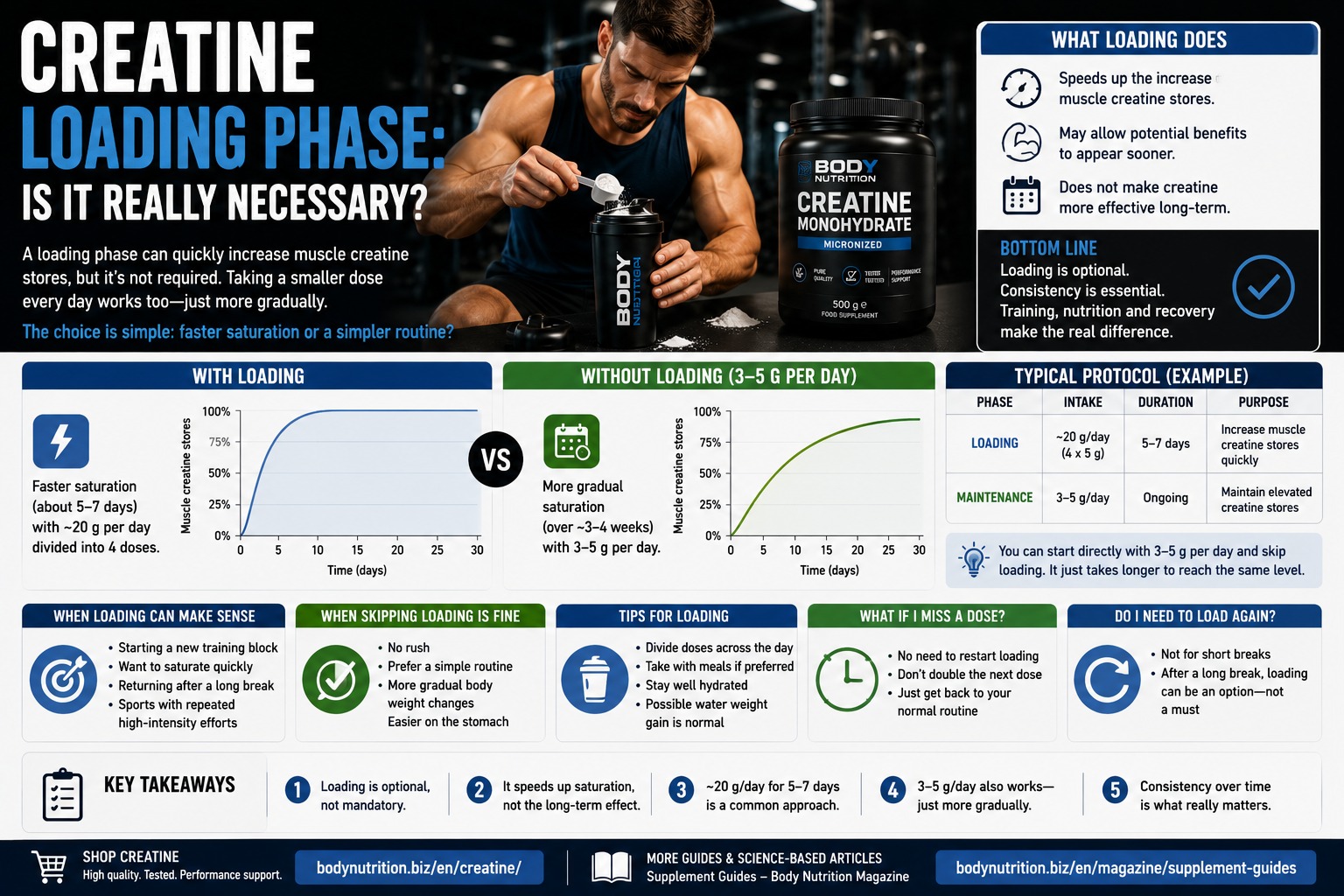
No, a loading phase is not required.
Instead of consuming around 20 g per day initially, you can start directly with approximately 3–5 g of creatine monohydrate every day.
Muscle creatine stores will still increase. The process simply occurs more gradually and may take several weeks rather than approximately one week.
Once similar levels of muscle saturation have been achieved, there is no reason to assume that someone who loaded will continue receiving a special advantage simply because they used a higher initial dose.
Loading vs 3–5 g per day: what is the difference?
| Creatine loading | Daily use without loading |
|---|---|
| Approx. 20 g/day initially | Approx. 3–5 g/day from the beginning |
| Usually divided into several servings | Usually one daily serving |
| Faster muscle saturation | More gradual muscle saturation |
| Potential benefits may appear sooner | Potential benefits develop more gradually |
| Initial body-weight increase may occur sooner | Body-weight changes may be more gradual |
| More complicated for several days | Very simple routine |
Both approaches can work. The main practical difference is how quickly muscle creatine stores increase.
How quickly does creatine work with loading?
With a conventional loading strategy, muscle creatine stores can increase substantially within approximately 5–7 days.
This makes loading attractive when someone wants to raise creatine stores quickly, for example before beginning a structured training block.
It is important, however, to understand what “working” means. Creatine is not a stimulant, so you should not necessarily expect a dramatic sensation immediately after taking it.
The benefit is related primarily to increased tissue creatine availability and its contribution to repeated high-intensity exercise.
How long does creatine take without loading?
When approximately 3–5 g are consumed each day without a loading phase, muscle stores rise progressively.
A commonly cited practical timeframe is approximately 3–4 weeks to approach levels that can be achieved much faster with loading, although individual responses vary.
This is why someone starting creatine today with a normal daily dose should not conclude after three days that the supplement “doesn't work”.
Does loading produce better long-term results?
Loading primarily changes the speed at which muscle creatine stores increase.
If two people eventually reach similar elevated creatine stores and continue an appropriate maintenance intake, the person who performed a loading phase does not automatically have a long-term advantage.
This distinction is important because loading is sometimes marketed as though it were essential for obtaining results.
It isn't. For someone planning to use creatine consistently for months, the difference between reaching saturation in roughly one week or over several weeks may ultimately be relatively minor.
When can a loading phase make sense?
Loading can be useful when rapid saturation is genuinely desirable.
Examples might include:
- starting creatine shortly before a new training block;
- wanting to reach elevated muscle stores as quickly as practical;
- returning to supplementation after a sufficiently long period without creatine;
- participating in a sport involving repeated high-intensity efforts and wanting to establish elevated stores quickly.
Even in these situations, loading remains an option rather than an obligation.
When is skipping the loading phase more practical?
For many recreational athletes, there is no urgency at all.
If you train throughout the year and plan to take creatine consistently, simply taking 3–5 g every day may be the easiest strategy.
Skipping loading can also be attractive for people who prefer:
- one simple daily serving;
- a more gradual increase in body weight;
- fewer large servings during the first week;
- the easiest possible supplementation routine.
In long-term supplementation, simplicity can be extremely valuable because consistency matters more than making the first week complicated.
Can loading cause stomach discomfort?
Some people may experience gastrointestinal discomfort when consuming relatively large amounts of creatine, particularly if a high daily amount is taken in one serving.
This is one reason loading protocols generally divide the total daily intake into several smaller servings.
For example, rather than consuming 20 g at once, a person might divide the amount into four servings of approximately 5 g throughout the day.
If simplicity and digestive comfort are priorities, starting directly with a normal daily dose is another reasonable option.
Should you take 20 g of creatine all at once?
There is generally no practical reason to consume the entire loading amount in a single serving.
A loading protocol is normally divided across the day.
This makes the strategy easier to tolerate and reflects how loading has commonly been implemented in research.
More creatine in one serving does not mean proportionally faster results.
Does creatine loading cause water retention?
Increasing muscle creatine stores is associated with an increase in body water, particularly within muscle tissue.
Because loading increases creatine stores rapidly, changes in body weight can also occur more quickly.
Some people may therefore notice an increase on the scale during the first week.
This should not automatically be interpreted as an increase in body fat. The early change is largely associated with water accompanying increased creatine storage.
How much weight can you gain during creatine loading?
There is no exact amount that applies to everyone.
The change depends on factors including body size, muscle mass, baseline creatine stores, diet and individual response to supplementation.
Some people notice a clear change on the scale, while others experience a much smaller difference.
The important point is that a rapid increase in body weight during the loading phase does not automatically mean fat gain.
Do you need a loading phase every time you restart creatine?
No.
If creatine supplementation has been stopped long enough for muscle stores to gradually return toward baseline, loading can once again increase them quickly.
But you can just as easily restart with a normal daily intake and allow stores to rise progressively.
The same principle applies as when starting creatine for the first time: loading changes the speed, not the fundamental destination.
What happens after the loading phase?
Once the initial loading period is complete, there is no need to continue consuming approximately 20 g every day.
The objective changes from rapidly increasing muscle stores to maintaining them.
A daily intake of approximately 3–5 g is commonly used for maintenance.
Creatine should generally continue to be taken consistently, including on days without training.
Do you need to load again after missing a few days?
Usually not.
Muscle creatine stores do not immediately return to baseline because you forgot creatine for one or several days.
If you miss a dose, simply return to your normal routine rather than automatically performing another loading phase.
There is also generally no need to double the next dose.
Should you load creatine before a competition?
This requires more consideration than simply asking whether loading increases muscle creatine quickly.
While rapid saturation may be useful for some sports, the accompanying increase in body water and body mass can matter in activities where body weight, weight categories or power-to-weight ratio are important.
Competition preparation should therefore consider the specific demands of the sport rather than applying the same strategy to every athlete.
Which creatine is best for loading?
Creatine monohydrate remains the most extensively researched form and is the standard choice for both loading and normal daily supplementation.
A loading phase does not require a special type of creatine marketed specifically for rapid absorption or loading.
If you want to compare available products, you can explore the Creatine category at Body Nutrition.
A practical example: loading vs no loading
Imagine two people starting creatine on the same day.
| Person A: Loading | Person B: No loading | |
|---|---|---|
| Days 1–5/7 | Approx. 20 g/day divided into servings | 3–5 g/day |
| After first week | 3–5 g/day | 3–5 g/day |
| Muscle saturation | Faster | More gradual |
| Long-term routine | 3–5 g/day | 3–5 g/day |
Person A reaches elevated muscle stores more rapidly. Person B takes longer, but eventually follows essentially the same maintenance strategy.
Neither approach is automatically “better”. The appropriate choice depends mainly on how quickly you want to increase your creatine stores and which routine you find easiest to follow.
Loading, timing and daily consistency
Whether you load or not, the same principle becomes increasingly important after the initial period: consistency.
Creatine supplementation works by increasing and maintaining tissue creatine stores. It does not depend on creating a brief stimulant-like effect immediately before a workout.
This means the exact time of day is usually less important than taking creatine regularly.
You can take it with a meal, after training, in a protein shake or at another convenient time.
Creatine loading: 6 points to remember
- A loading phase is optional.
- Its main advantage is faster muscle saturation.
- A commonly studied protocol is around 0.3 g/kg/day for 5–7 days.
- The daily loading amount should normally be divided into several servings.
- Taking 3–5 g/day without loading can also increase muscle creatine stores.
- Once stores are elevated, a regular maintenance intake is the important part.
For more practical information about supplement use, dosage and product selection, visit the Supplement Guides section of the Body Nutrition Magazine.
Conclusion: do you really need to load creatine?
No. You do not need a loading phase for creatine to work.
Loading is simply a faster route to elevated muscle creatine stores. If speed matters, a short loading period followed by a maintenance dose can be useful.
If there is no urgency, taking approximately 3–5 g of creatine monohydrate every day is a much simpler approach that can gradually achieve the same objective.
For most people, the best strategy is therefore the one they can follow consistently. Whether you reach saturation quickly or gradually, creatine remains a support to training — progressive exercise, adequate nutrition and recovery are still what ultimately drive results.
Frequently asked questions
Do I have to load creatine for it to work?
No. Taking approximately 3–5 g per day without loading can also increase muscle creatine stores; it simply takes longer.
How much creatine should I take during loading?
A commonly studied strategy is approximately 0.3 g/kg/day for 5–7 days, often simplified to around 20 g per day divided into several smaller servings.
How long does creatine loading take?
A conventional loading phase generally lasts approximately 5–7 days before switching to a lower maintenance intake.
Is 20 g of creatine per day necessary?
No. That amount is associated with rapid loading protocols. It is not necessary for normal long-term creatine supplementation.
What happens if I don't load creatine?
Muscle creatine stores increase more gradually. With consistent daily supplementation, you can still reach elevated stores without a loading phase.
Should I load creatine again after missing a dose?
No. Missing a single dose does not rapidly deplete muscle creatine stores. Simply continue with your normal daily intake.
Recommended products
Share this article: