Shopping Cart
Leucine, BCAAs and the mTOR pathway: how whey drives muscle protein synthesis


Whey protein is particularly effective for supporting muscle growth because it provides all nine essential amino acids (EAAs) and is naturally rich in leucine. Leucine acts as an important nutrient signal for muscle protein synthesis (MPS), while the complete EAA profile provides the building blocks needed to produce new muscle proteins.
Combined with resistance training and an adequate total daily protein intake, whey offers a practical way to support recovery, adaptation and muscle hypertrophy.
Why whey protein is effective for muscle protein synthesis
Whey is a complete, rapidly digested protein with a high proportion of essential amino acids. Leucine typically represents around 10–12% of whey protein, although the exact amino acid profile varies between products.
A serving providing approximately 25 g of whey protein will often supply roughly 2.5–3 g of leucine together with the other EAAs required for muscle protein synthesis.
If you are comparing supplements, you can browse the protein range at BodyNutrition, including whey concentrates, isolates, blends and other protein sources.
How leucine activates the mTORC1 pathway
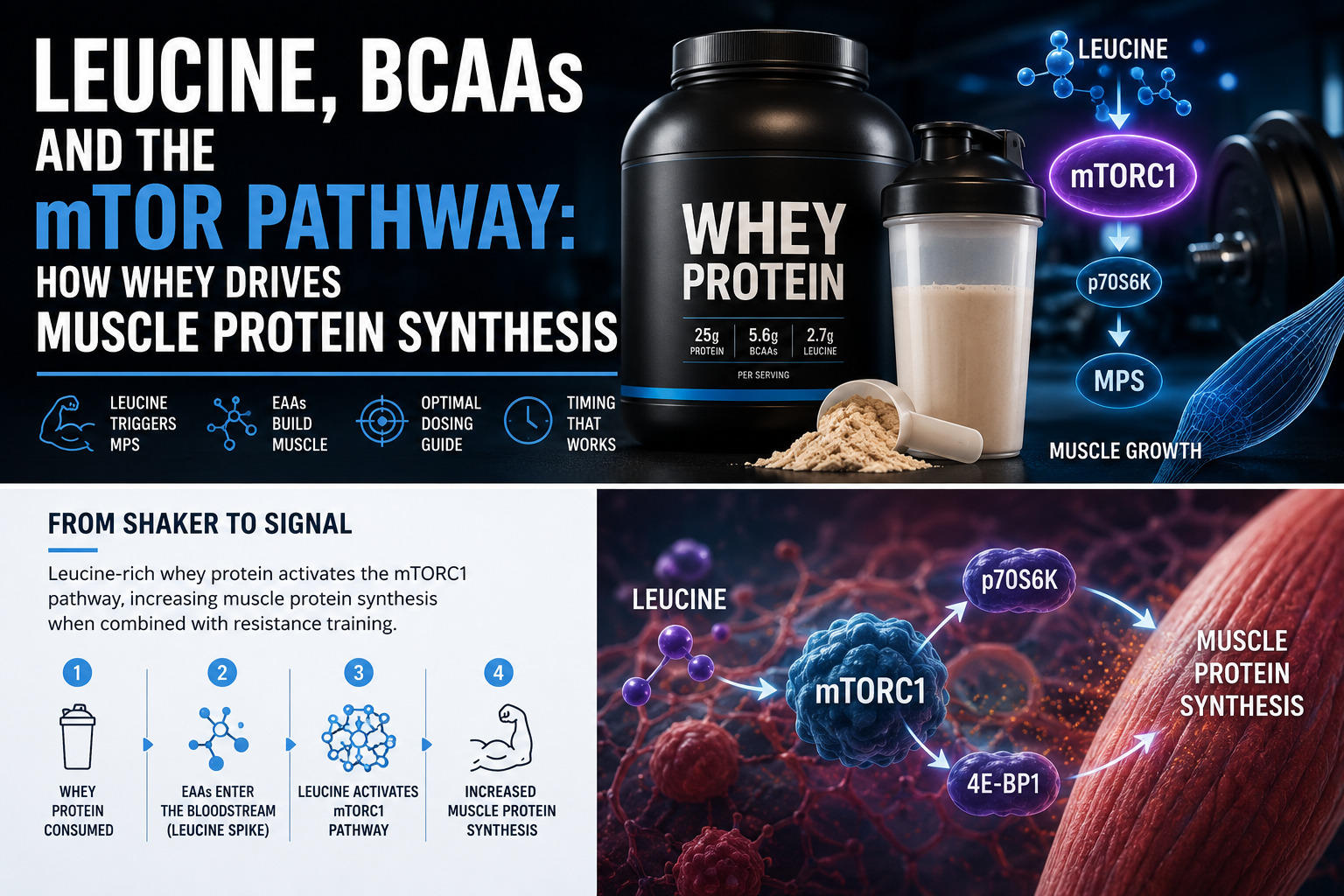
Muscle growth is regulated by a complex network of cellular signals. One of the most important is the mechanistic target of rapamycin complex 1, better known as mTORC1.
After a leucine-rich protein such as whey is consumed:
- Whey is digested and essential amino acids enter the bloodstream.
- Leucine acts as a nutrient signal involved in the activation of mTORC1.
- mTORC1 regulates downstream proteins involved in translation and muscle protein synthesis.
- The remaining essential amino acids provide the raw materials required to build new muscle proteins.
Resistance exercise provides a powerful mechanical stimulus, while dietary protein supplies amino acids and nutritional signals. This is why resistance training and adequate protein intake work together rather than functioning as interchangeable strategies.
Leucine, EAAs and BCAAs: what is the difference?
Leucine acts as an anabolic signal
Leucine has a particularly important role in signalling pathways associated with MPS. Rather than treating a specific amount as a universal “on/off” threshold, a practical approach is to consume a sufficient serving of high-quality protein that naturally provides a meaningful amount of leucine.
For many adults, approximately 20–40 g of high-quality protein per meal is a useful general range, although individual requirements vary according to body size, age, training status, total energy intake and the type of exercise performed.
Essential amino acids provide the building blocks
Leucine cannot build muscle tissue by itself. Muscle protein synthesis requires all of the essential amino acids.
This distinction is important: leucine helps provide an anabolic signal, while the complete EAA pool supplies the amino acids required to sustain the synthesis of new proteins.
For this reason, athletes interested specifically in amino acid supplementation should consider the complete essential amino acids (EAAs) range rather than assuming that leucine or BCAAs alone provide everything required for muscle protein synthesis.
Do BCAAs replace complete protein or EAAs?
No. The three branched-chain amino acids — leucine, isoleucine and valine — are part of the EAA group, but they do not provide all nine essential amino acids.
If your diet already supplies enough high-quality protein, additional BCAA supplementation is unlikely to substitute for the nutritional value of a complete protein source. Whey naturally combines a high leucine content with the complete EAA profile needed to support MPS.
How much protein should you consume per meal?
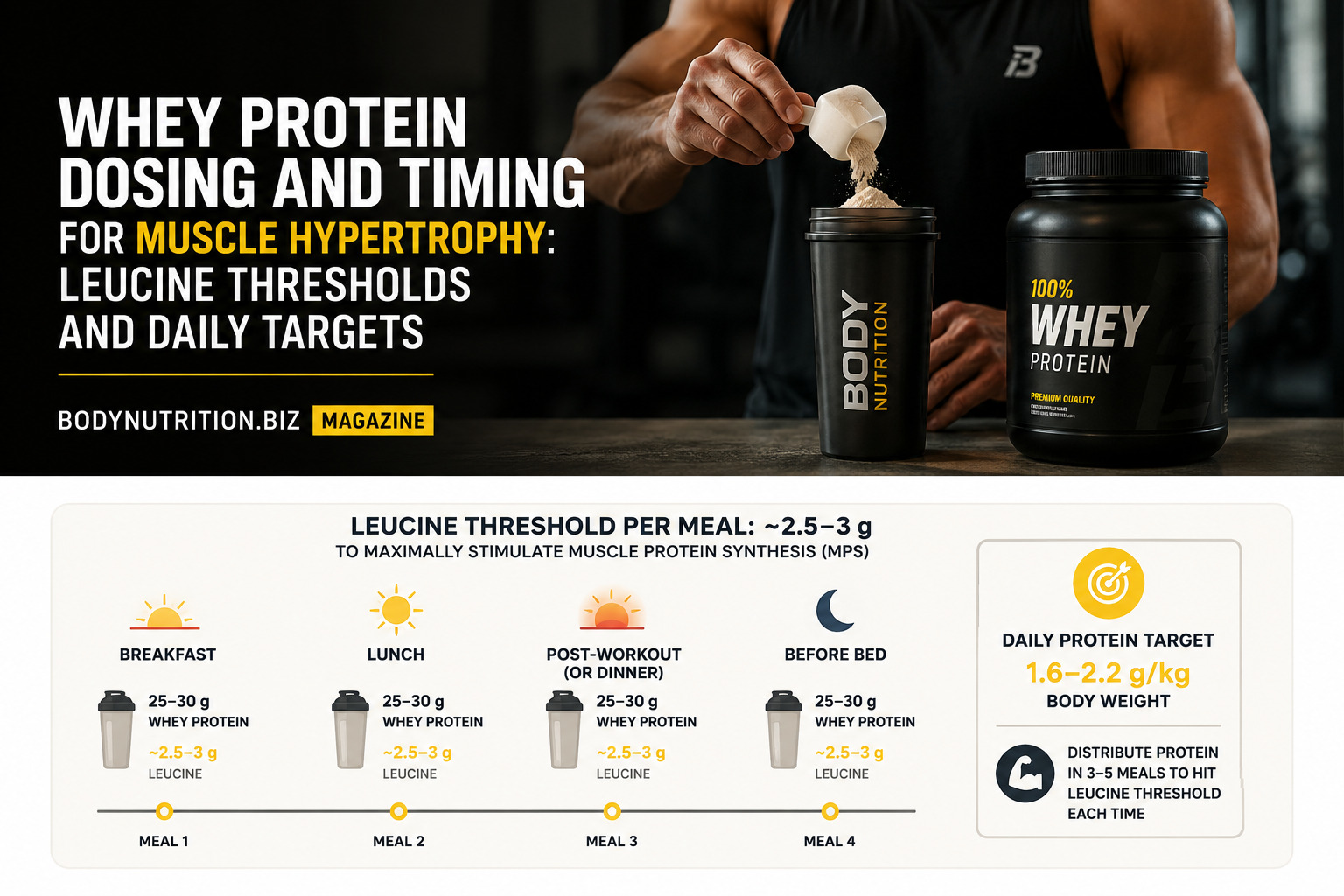
There is no single dose that is optimal for everyone. Research-based sports nutrition recommendations commonly use approximately 0.25 g of high-quality protein per kilogram of body weight per meal, or roughly 20–40 g per serving, as a practical starting point.
Older adults may benefit from the upper end of this range because the muscle protein synthetic response to dietary protein can become less sensitive with age.
Examples of practical servings include:
- 70 kg athlete: roughly 20–30 g of high-quality protein can be a reasonable starting point.
- 90 kg athlete: roughly 25–40 g may be more appropriate depending on training, diet and goals.
The exact leucine content depends on the product, but a typical whey serving usually provides a substantial amount naturally.
How much protein per day for muscle growth?
Total daily protein intake is more important than obsessing over a narrow post-workout window.
For resistance-trained adults, an intake around 1.6 g/kg/day is sufficient for many people seeking to maximise gains in muscle mass. Depending on individual circumstances — including energy intake, training volume and body-composition goals — higher intakes approaching roughly 2.0–2.2 g/kg/day may provide a practical margin.
Rather than consuming most of that protein in one meal, spreading adequate servings across several meals during the day is a practical strategy for repeatedly providing the muscles with essential amino acids.
Does protein timing matter?
Timing matters less than meeting your overall protein and calorie requirements, but it can still be useful in practice.
A whey shake before or after resistance training is a convenient way to consume a high-quality protein serving when it fits your routine. The anabolic response to resistance exercise persists well beyond the minutes immediately following a workout, so there is no need to panic about an extremely narrow “anabolic window”.
A practical approach is to distribute protein-containing meals throughout the day, commonly at intervals of around three to four hours, while prioritising your total daily intake.
Which type of whey should you choose?
The main whey formats all provide high-quality protein and essential amino acids. The best choice usually depends more on digestion, budget and personal preference than on dramatic differences in muscle-building potential.
- Whey protein concentrate (WPC): generally the most economical option and suitable for most people who tolerate dairy well.
- Whey protein isolate (WPI): typically contains a higher proportion of protein with less lactose, carbohydrate and fat.
- Hydrolysed whey: contains partially broken-down proteins and is rapidly digested, although the practical advantage for muscle growth over conventional whey is likely modest for most athletes.
- Clear whey: usually isolate-based and designed to produce a lighter, juice-style drink rather than a traditional creamy shake.
For a more detailed comparison, see our guide to protein powder types and how to choose the right one.
Can whey build muscle without resistance training?
Protein ingestion can stimulate muscle protein synthesis, but consuming whey alone is not a substitute for resistance training.
Progressive resistance exercise provides the training stimulus that drives muscular adaptation. Adequate protein then helps provide the amino acids required for repair, recovery and the development of new muscle tissue.
For hypertrophy, the priorities remain consistent resistance training, sufficient total energy, adequate daily protein and recovery.
Whey protein and post-workout recovery
Whey is convenient after training because it is rapidly digested and makes it easy to consume a meaningful dose of high-quality protein and leucine.
However, the benefits should not be exaggerated. A post-workout shake cannot compensate for inadequate protein intake during the rest of the day, insufficient calories, poor sleep or an ineffective training programme.
Think of whey as a practical nutritional tool rather than a shortcut to muscle growth.
Key takeaways
- Whey provides leucine and all nine EAAs: this combination makes it particularly effective for supporting muscle protein synthesis.
- Leucine is an important signal, not the whole process: all essential amino acids are required to build new muscle proteins.
- Complete protein generally makes more sense than BCAAs alone: especially when the goal is hypertrophy.
- A practical serving is often 20–40 g of high-quality protein: individual needs depend on body size, age, training and diet.
- Total daily protein matters most: around 1.6 g/kg/day is sufficient for many resistance-trained adults, with higher intakes potentially useful in some circumstances.
- Resistance training remains essential: protein supports the adaptation created by training; it does not replace it.
Safety and practical considerations
Whey protein is generally well tolerated by healthy adults when used as part of a balanced diet. People with a milk allergy should avoid whey, while those with lactose intolerance may tolerate whey isolate better because it generally contains less lactose than concentrate.
People with kidney disease, metabolic disorders or other medical conditions that may require dietary protein restriction should seek individual medical advice before substantially increasing protein intake or using protein supplements regularly.
Frequently asked questions
Is leucine more important than the other essential amino acids?
Leucine has a particularly important signalling role in muscle protein synthesis, but it cannot sustain new muscle protein production by itself. All nine essential amino acids are required as building blocks.
How much whey protein should I take per serving?
For many active adults, approximately 20–40 g of high-quality protein per serving is a useful general range. Your optimal amount depends on body weight, age, total daily protein intake and training.
Are BCAAs necessary if I already use whey protein?
Usually not for the purpose of supplying BCAAs themselves. Whey already contains substantial amounts of leucine, isoleucine and valine together with the other essential amino acids. Your overall diet and total protein intake are more important.
Should I drink whey immediately after training?
You do not need to consume it within minutes of your final set. Whey after training is convenient, but the overall amount and distribution of protein throughout the day are more important than hitting an extremely narrow post-workout window.
Is whey isolate better than whey concentrate for building muscle?
Not necessarily. Both provide high-quality complete protein. Isolate generally provides more protein per gram and less lactose, carbohydrate and fat, while concentrate is often more economical. Choose according to your diet, digestion, budget and preferences.
Recommended products

Share this article: