Shopping Cart
Whey protein dosing and timing for muscle hypertrophy: leucine thresholds and daily targets


Building muscle is not simply a matter of eating “more protein.” For resistance-trained adults, the total amount of protein consumed each day matters, but so do protein quality, how that intake is distributed across meals, and whether each serving provides enough essential amino acids (EAAs) to support muscle protein synthesis (MPS).
Whey protein is particularly useful because it is rapidly digested, contains all nine essential amino acids, and is naturally rich in leucine. This makes it an efficient way to reach a meaningful protein dose around training or whenever a meal is short on high-quality protein.
This guide explains how much protein to aim for each day, how much to consume per meal, the practical role of leucine, when whey can be useful around resistance training, and how whey, casein and plant proteins can fit into a muscle-building diet.
Why whey protein is effective for muscle hypertrophy
Resistance training provides the mechanical stimulus that drives muscular adaptation. Dietary protein provides the amino acids needed to repair existing proteins and build new muscle tissue.
Whey protein is especially useful because it combines three important characteristics:
- it contains all nine essential amino acids;
- it is naturally rich in leucine;
- it is digested relatively quickly.
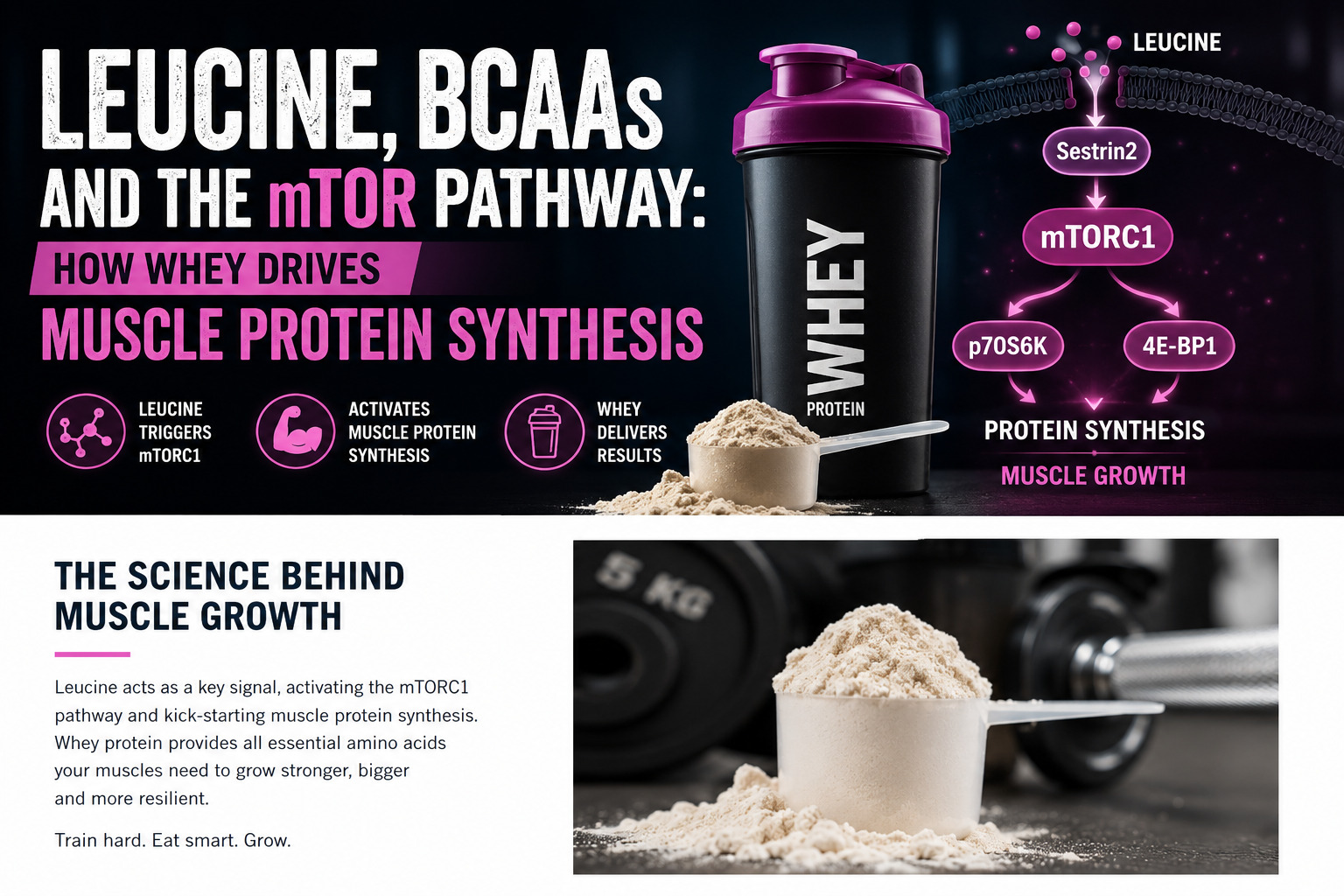
Leucine plays an important signalling role in pathways associated with muscle protein synthesis, including mTORC1. However, leucine alone cannot build muscle. The complete spectrum of essential amino acids must also be available as building blocks.
This is why a complete protein such as whey is generally more useful for hypertrophy than relying on standalone BCAA supplementation.
You can browse the protein range at BodyNutrition if you want to compare whey concentrates, isolates, blends and other protein sources.
Leucine, EAAs and muscle protein synthesis
Leucine acts as a signal
Leucine is one of the three branched-chain amino acids and has a particularly important role in signalling pathways involved in MPS.
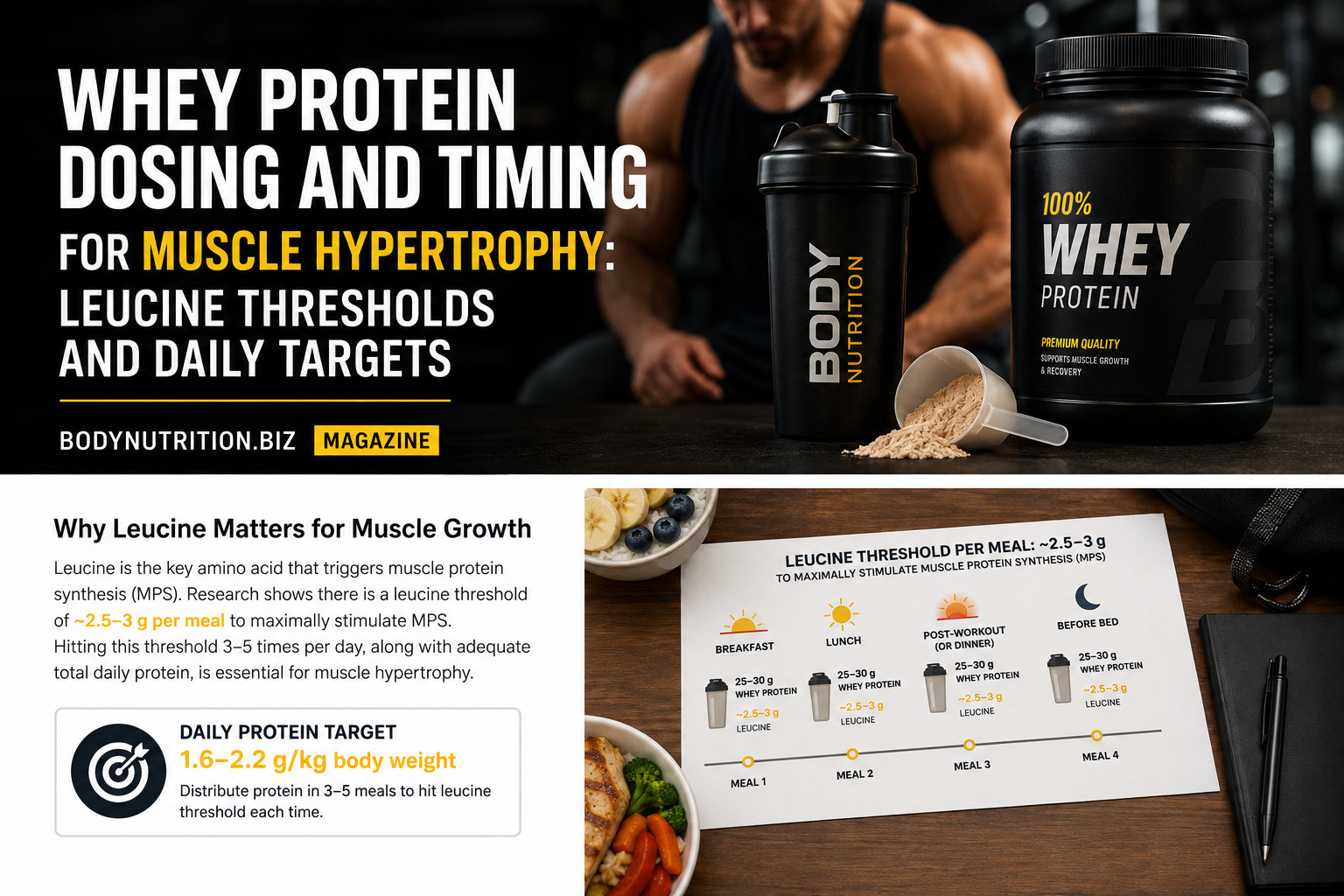
You will often see a “leucine threshold” of roughly 2–3 g per meal mentioned in sports nutrition. It is better to think of this as a practical target rather than a universal biological switch. The optimal amount varies according to body size, age, training status, protein source and the rest of the meal.
A typical serving of whey providing around 20–30 g of protein will usually deliver a substantial amount of leucine naturally.
EAAs provide the building blocks
Leucine can help initiate anabolic signalling, but muscle protein synthesis requires all essential amino acids.
This distinction is important when comparing supplements. BCAAs provide leucine, isoleucine and valine, but they do not provide the other six essential amino acids needed to support complete new protein synthesis.
If your goal is to supplement amino acids rather than use a whole protein powder, see the essential amino acids range.
How much protein per day for muscle growth?
For people performing regular resistance training, approximately 1.6 g of protein per kilogram of body weight per day is a useful evidence-based target for many individuals.
Depending on training volume, calorie intake, age, body-composition goals and individual circumstances, some athletes may choose intakes closer to approximately 2.0–2.2 g/kg/day.
Higher intakes are not automatically better. Once protein requirements are comfortably met, total calorie intake, progressive training, sleep and recovery become increasingly important.
Daily protein examples
- 70 kg athlete: around 112 g/day at 1.6 g/kg, with higher intakes possible depending on goals.
- 85 kg athlete: around 136 g/day at 1.6 g/kg.
- 90 kg athlete: around 144 g/day at 1.6 g/kg.
These are reference points rather than rigid prescriptions.
How much protein should you eat per meal?
A practical per-meal target for many active adults is approximately 0.25–0.40 g of high-quality protein per kilogram of body weight.
For most people, this corresponds to roughly 20–40 g of high-quality protein per meal.
Older adults may benefit from servings toward the upper end of this range because the muscle protein synthetic response to protein can become less sensitive with age.
Practical examples
- 70 kg person: roughly 20–30 g high-quality protein per meal.
- 85 kg person: roughly 25–35 g per meal.
- Larger or older lifters: servings closer to 30–40 g may be appropriate.
The goal is not to calculate every meal with laboratory precision. A more useful strategy is to make sure that several meals across the day contain meaningful servings of complete protein.
How much leucine does whey provide?
Whey is naturally one of the more leucine-rich dietary proteins. Exact values vary by product, but leucine commonly represents roughly 10–12% of its protein content.
As a practical approximation:
- 20 g whey protein may provide around 2 g or more leucine;
- 25 g whey protein commonly provides roughly 2.5–3 g leucine;
- 30 g whey protein generally provides comfortably above 3 g in many products.
These values depend on the actual amino acid profile of the product, so they should be treated as estimates rather than guaranteed amounts.
Whey, casein and plant proteins: different ways to reach your target
Whey protein
Whey is rapidly digested, high in EAAs and rich in leucine. This makes it convenient around training or whenever you need an easy way to increase total protein intake.
Casein protein
Casein is digested more slowly and produces a more prolonged release of amino acids. It can be useful before a long period without food, including before sleep.
There is no requirement to use casein at night, but it can be a convenient option for people who struggle to reach their daily protein target through meals alone.
Plant-based protein
Plant proteins can also support muscle growth when total protein intake and essential amino acid availability are adequate.
Some individual plant proteins contain less leucine or lower amounts of particular EAAs per gram than whey. Blends such as pea and rice protein can help provide a more balanced amino acid profile.
Plant-based athletes may therefore benefit from slightly larger servings or well-formulated protein blends.
Protein timing: how important is the anabolic window?
The importance of an extremely narrow post-workout “anabolic window” is often exaggerated.
Resistance training increases the muscle’s responsiveness to dietary protein for many hours after exercise. The most important priorities remain:
- meeting your total daily protein target;
- consuming adequate protein servings throughout the day;
- training progressively and consistently.
That said, consuming protein reasonably close to training is practical and can help ensure amino acids are available during recovery.
Post-workout protein
A serving of approximately 20–40 g of high-quality protein after resistance training is a practical choice for many people.
Whey is particularly convenient because it is easy to digest, portable and rich in leucine.
If you trained after eating a protein-rich meal one or two hours earlier, there is usually no reason to rush to drink a shake immediately after your final set.
Training fasted
If you train after a prolonged period without food, consuming a protein-rich meal or shake soon after training becomes more relevant because you have not already supplied amino acids before the session.
Pre-workout protein
A protein-containing meal consumed one to three hours before training can provide circulating amino acids during the session and early recovery.
In this situation, the urgency of immediate post-workout protein is lower.
How should protein be distributed throughout the day?
Instead of consuming very little protein during most of the day and then eating a very large amount at dinner, it is generally more practical to distribute protein across several meals.
For many athletes, 3–5 protein-containing meals per day works well.
A gap of roughly three to five hours between substantial protein meals is a practical pattern, although there is no need to treat the clock as an exact physiological rule.
Example for a 70 kg lifter
If the target is around 120–130 g protein per day:
- Breakfast: 30 g protein
- Lunch: 30–35 g protein
- Post-workout or afternoon meal: 25–30 g protein
- Dinner or pre-sleep meal: 30–35 g protein
Example for an 85 kg lifter
If the target is around 150–170 g protein per day:
- Meal 1: 35 g protein
- Meal 2: 35 g protein
- Pre- or post-training: 30–35 g protein
- Dinner: 35 g protein
- Optional additional feeding: 20–30 g protein
The exact distribution is flexible. Consistency with your daily target matters more than following a perfect timetable.
Which type of whey is best for hypertrophy?
Whey concentrate, whey isolate and hydrolysed whey all provide complete, leucine-rich protein.
The choice is usually based more on digestion, lactose tolerance, calorie requirements, texture and budget than on dramatic differences in muscle-building potential.
- Whey concentrate: economical, effective and suitable for most people who tolerate lactose.
- Whey isolate: higher protein concentration with generally less lactose, carbohydrate and fat.
- Hydrolysed whey: partially broken down for rapid digestion, although the practical advantage for hypertrophy is usually modest.
- Clear whey: commonly isolate-based and useful for people who prefer a lighter, juice-style drink.
For a full comparison, read our guide to protein powder types and how to choose the right one.
Does casein before bed improve muscle growth?
Consuming protein before sleep can provide amino acids during the overnight fasting period.
Casein is often used because of its slower digestion, although whole-food protein sources can also work.
A serving providing roughly 30–40 g of high-quality protein before sleep can be a practical strategy for athletes who need additional protein to reach their daily target.
It is not mandatory if total daily protein intake is already adequate and your meal pattern works well.
What changes during a calorie deficit?
When calories are restricted, preserving muscle becomes more challenging.
Protein needs may increase depending on how lean the athlete is, the size of the calorie deficit, training volume and duration of the diet.
In this situation:
- keep resistance training in place;
- maintain high-quality protein throughout the day;
- avoid unnecessarily large calorie deficits;
- consider protein intakes toward the upper end of the practical range.
Whey can be useful because it provides a relatively high amount of protein for a modest number of calories.
What changes for older lifters?
Older adults may experience a reduced muscle protein synthetic response to a given amount of protein, sometimes described as anabolic resistance.
This does not mean protein stops working. It means that larger high-quality protein servings may be useful.
Practical priorities include:
- using meaningful protein servings at each meal;
- including leucine-rich complete proteins;
- maintaining progressive resistance training;
- meeting total daily energy and protein requirements.
Can you combine whey and creatine?
Yes. Whey protein and creatine perform different roles and can be used together.
Whey provides amino acids needed for protein synthesis, while creatine helps increase the availability of rapid energy during high-intensity exercise and can support training performance over time.
A common creatine strategy is approximately 3–5 g of creatine monohydrate per day. Timing is much less important than consistent daily use.
Mixing creatine into a whey shake after training can simply be a convenient way to remember both supplements.
Common protein dosing mistakes
Using a shake without checking the actual protein content
A scoop of powder is not always the same as a scoop of protein. Read the nutrition label and check how many grams of actual protein the serving provides.
Relying on BCAAs instead of complete protein
BCAAs cannot replace a complete EAA source when the goal is to provide all the building blocks required for new muscle proteins.
Eating most of your protein at dinner
Total daily intake remains important, but distributing substantial protein servings throughout the day provides repeated opportunities to support MPS.
Obsessing over the post-workout window
There is no need to panic if you cannot drink a whey shake immediately after training. Your total daily protein intake and overall meal pattern are more important.
Ignoring calories
Protein cannot compensate for an inappropriate total energy intake. Muscle gain is easier when training is progressive and energy availability is sufficient.
Practical whey dosing checklist
- Aim for approximately 1.6 g/kg/day protein as a useful starting point for muscle growth.
- Higher intakes approaching roughly 2.0–2.2 g/kg/day may be useful in some circumstances.
- Use approximately 20–40 g of high-quality protein per meal as a practical general range.
- Include complete proteins that provide all essential amino acids.
- Use whey when convenience, speed of digestion or leucine density are useful.
- Distribute protein across roughly 3–5 meals rather than concentrating almost everything into one meal.
- Do not obsess over a narrow anabolic window.
- Adjust protein intake according to body size, age, calorie intake and training goals.
Frequently asked questions
How much protein do I need per day to build muscle?
Around 1.6 g/kg/day is a useful evidence-based target for many resistance-trained adults. Some individuals may choose intakes closer to 2.0–2.2 g/kg/day depending on their goals, calorie intake and training.
How much protein should I eat at each meal?
Approximately 20–40 g of high-quality protein per meal is a practical general range, or roughly 0.25–0.40 g/kg depending on body size, age and individual circumstances.
How much leucine should a meal provide?
Around 2–3 g is often used as a practical leucine target in sports nutrition, but it should not be treated as an identical threshold for every person. A normal serving of whey protein usually provides a meaningful amount naturally.
How much whey should I take after training?
For many adults, a serving providing approximately 20–40 g of protein is appropriate. The exact amount depends on body size and the protein consumed before and after the workout.
Do I need whey immediately after my workout?
No. If you consumed protein before training, there is usually no urgent need to drink whey immediately afterwards. If you trained fasted, consuming protein soon after the workout becomes more relevant.
Is whey better than casein for muscle gain?
Both are complete proteins. Whey is rapidly digested and leucine-rich, while casein provides a slower amino acid release. Your total daily protein intake matters more than choosing one exclusively.
Are BCAAs useful if I already drink whey?
Whey already provides substantial amounts of leucine, isoleucine and valine together with all the other essential amino acids. For people consuming adequate high-quality protein, additional BCAA supplementation is generally less important.
Bottom line
For muscle hypertrophy, start with the fundamentals: progressive resistance training, sufficient calories and an adequate daily protein intake.
For many lifters, around 1.6 g/kg/day is a strong starting point, distributed across several meals containing approximately 20–40 g of high-quality protein.
Whey is useful because it is complete, rapidly digested and naturally rich in leucine. It can help you reach your protein target around training or anywhere else in the day, but there is no need to obsess over an exact leucine threshold or an extremely narrow anabolic window.
Use whey as a convenient tool within a well-designed diet and training programme, not as a replacement for either.
Medical note: If you have kidney disease or another medical condition that affects protein metabolism or dietary protein recommendations, consult a qualified healthcare professional before significantly increasing your protein intake or using supplements regularly.
Share this article: